Sponsored by
We are currently seeking a sponsor for this website
as it follows the progress of the excavations on the battlefield, with contributions from established historians and well known experts, as the team attempt to match the historical evidence and family history to the archaeology on the ground.
If you enjoy this website
please consider making a donation towards the costs of the project.

|
A German contribution – Ein deutscher Beitrag Tuesday, July 24th, 2007
|
|
|
|
|
Mein Name ist Swantje Krause und ich absolviere zurzeit ein Masterstudium an der Bournemouth Universität in England in Forensischer und Biologischer Anthropology. Ich arbeite mit menschlichen Knochen, die ich untersuche, um ein sogenanntes biologisches Profil zu erstellen, welches mir Auskunft über die Abstammung, das Geschlecht, das Alter und die Größe eines Individuums geben kann.
_
In der Woche vom 30. Juli bis 3. August werde ich an der Seite von Engländern, Belgiern, Franzosen, Deutschen und Australiern an einer archäologischen Ausgrabung in Ploegsteert (engl. Plugstreet), ein kleiner Ort in der Nähe von Ypern im Süd-Westen Belgiens, arbeiten. Dieses Team arbeitet gemeinsam an einem Projekt von „No Man’s Land“, einer europäischen Vereinigung, die sich mit historischen Kriegsschauplätzen aus dem Ersten Weltkrieg archäologisch beschäftigt und dadurch versucht Hintergründe und Zusammenhänge zu ermitteln. Die Leitung über dieses Projekt wird von Martin Brown und Richard Osgood, zwei Archäologen des Britischen Verteidigungsministeriums, übernommen. Der Schwerpunkt der Arbeit wird darin bestehen Informationen über die Dritte Division der Australier zu erlangen, die damals in Messines kämpften. Die Schlacht um Messines gilt als eine der blutigsten Schlachten des ersten Weltkrieges. Die Gegend ist durch gewaltige Krater gezeichnet, erzeugt durch massive Minenexplosionen. Am 7 Juni 1917 zündete die Britische Zweite Armee 19 Minen, mit einer Sprengkraft von ca. 600 Tonnen, unter Deutschen Linien. 10.000 Mann verloren damals während der Explosion ihr Leben. Die gewaltigen Explosionen waren angeblich bis Dublin zu hören.
_
Mit Spannung erwarte ich das Projekt und hoffe, dass das Wetter angenehm sein wird, so dass wir in der kurzen Zeit vernünftig arbeiten können, und dass wir neben Artefakten auch Überreste finden, die wir gegebenenfalls identifizieren und zurück in die entsprechenden Länder überführen können. Zudem hoffe ich, dass ich in einem netten, internationalen Team einen Beitrag zur Geschichte leisten kann.
|
|
|
|
|
|
Filed under: A Dig Diary by
admin
Add a Comment »
|
|
Our partners from Comines-Warneton Tuesday, July 24th, 2007
|
|
|
|
|
We have received emails from Jean-Michel, on behalf of the Comines-Warneton Historical Society. They are our key, local partners in the Plugstreet Project. Members of the group will be working with us on site and they have already helped with documentary research. Some members of the Society have plenty of experience in Great War archaeology and one member was associated with discovery and identification of Private Lancaster, about whom I wrote on 4th July. We are looking forwards to working with them.
_
Like us they have a blog and it includes details of two Great War exhibitions, as well as photos of the Flanders Giants, which are quite a phenomenon.
_
http://www.vanelslande.org/blog
_
We intend that the excavation report will appear in the Society’s Journal.
|
|
|
|
|
|
Filed under: A Dig Diary by
admin
Add a Comment »
|
|
Initial German Perspective Friday, July 20th, 2007
|
|
|
|
|
For those who do not know me my name is Ralph Whitehead and I am what can be described as an historian with NML. I am quite pleased to be able to attend another NML dig and hopefully assist in identifying any finds the group makes. The Australian contingent is well represented and I look forward to meeting old friends and make some new ones. Some of you already know me and my interest in the German army. Hopefully all of the different perspectives of the fighting will allow us to piece together a better idea of the fighting and events that took place some 90 years ago.
_
In looking over the German side of the battle we will probably be running into men who served in the 9th Bavarian Infantry Regiment, an active regiment in the 4th Bavarian Division. This regiment or the others in the division, the 5th Bavarian IR and 5th Bavarian RIR held this portion of the line for some months prior to the attack. On 7 June 1917 the regiment had taken over from the 5th Bavarian RIR that had suffered heavy losses due to artillery fire. The III Battalion (9th, 10, 11th and 12th Companies) took over the sector where the mines were detonated, in fact the 12th Coy was positioned directly above the Ultimo mine. When the mines were set off this company suffered the worst losses followed by the 10th and 11th Companies, both of which lost a major part of their men in the initial blasts. The 9th Company was located in the intermediate terrain between the front line and the second line of defence. They occupied shell craters and strong points.
_
I looked over the available records for these units (9th and 5th Bavarian have regimental histories while the 5th Bavarian RIR did not publish anything in the post-war years). The 9th Bavarian IR had seen service in all main areas of the Western Front other than the fighting at Verdun in 1916. After reviewing the losses suffered by the regiment I found that the III Bn was the hard luck battalion in that they lost more men than the rest and the 12th Coy was the hard luck company having lost more men in the war by far than any other company in the regiment.
_
An example of this was the time they served on the Somme from 31 August 1916 through 18 September. In this period the regiment suffered heavily in the tank attack at Flers on 15 September where the III Battalion was virtually destroyed. The total losses for the 19 day period was 5 officers, 182 men killed; 20 officers, 776 men wounded and 20 officers, 540 men missing for a total of 45 officers and 1,498 men.
_
These losses required replacements and as such the men who were manning the trenches on 7 June were between the ages of 18 and 39. The losses suffered by the German Army required calling up the 1917 and 1918 Class of men early. 36 of the III Bn losses on 7 June were from these two classes.
_
In looking at the total losses for the regiment in the war the 9th Bavarians lost 3,758 officers and men killed; 134 officers and men who died from disease or accident; 346 officers and men missing; 8,630 officers and men wounded; 1,260 officers and men captured for a total of 14,128 casualties in the war.
_
In looking further at the losses I noted that one man from the 12th Coy listed as killed and presumed dead was a man born in New York. He was one of 6 fatal casualties that were born in the U.S. in this regiment, 4 from New York, 1 from Pennsylvania and one from a state yet to be identified. If these 6 were killed then I would suspect there would have been others serving in this regiment from the U.S. as well.
_
I will have additional details on the names of the men who have known graves and those we might possibly come across during the excavation as well as details on the uniforms and equipment most likely to be found as well. If anyone has any specific questions or inquiries please let me know over the next week or so and I will make sure I bring this information with me.
_
See you at the end of the month, possibly in Comines, possibly at Ypres, but eventually at Messines.
_
Ralph
|
|
|
|
|
|
Filed under: A Dig Diary by
admin
Add a Comment »
|
|
An Australian Perspective Thursday, July 19th, 2007
|
|
|
|
|
This is Michael Molkentin here. I am a historian and teacher from Wollongong, Australia; and following Richard’s gracious invitation, will be attending the Ploegsteert excavation.
_
As a historian who has only experienced the Battle of Messines through paper records, I am curious to see how archaeology can contribute to our understanding of the battle. Pouring over the multitude of maps, war diaries and private accounts of the 33rd Battalion’s advance at Trench 122, I have often struggled to visualise things like fields of fire, distances, the impact of flanks etc. These things should become clearer by just walking the ground, but given Flanders apparently (now) featureless geography, getting down into the dirt is probably the only way that we will really be able to appreciate the layout of the battle.
_
From an Australian perspective I also hope that this project will ignite some popular interest in Western Front operations. Here in Australia most people tend to think that Australia’s First World War experience began and ended at Gallipoli in 1915. Where there is some interest, it is usually based on a series of ‘Blackadder’ or Wilfred Owen style stereotypes. For example, when I recently spoke with a well-read ex-school principal about his grandfather who went missing during the Battle of Messines he commented “Tactics in the First World War? What tactics?”. Believe me, after trawling through hundreds of pages of operations orders for the Messines operation there were certainly tactics employed. Major General Monash is reported to have even specified the distinct movements of individual sections in his scheme for the attack!
_
I have attached some results of some of my recent work at the Memorial. Firstly there is a sketch map of the crater that was consolidated by A Company on 7 June 1917. As it was right on the exposed flank of the entire operation it came under heavy fire. Most of the platoon tasked with taking it were killed and it was held throughout the day by seven men. That night, help arrived and established wired posts armed with Lewis guns.
_
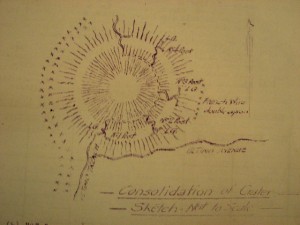
_
The second map demonstrates the 33rd Battalion’s objectives for 7 June 1917, all of which it achieved. Remarkably, the black line that the troops managed to dig very closely matched that prescribed in the operation orders before the attack.
_
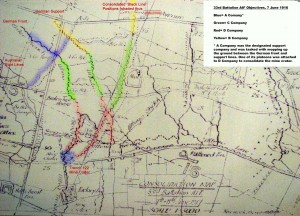
_
Michael
|
|
|
|
|
|
Filed under: A Dig Diary by
admin
2 Comments »
|
|
Of maps and men Tuesday, July 17th, 2007
|
|
|
|
|
Yesterday we had our chum Peter Chasseaud visit. Peter is the foremost expert on the maps of the Great War as well as the Plug Street Project’s artist in residence. He had brought some maps over and a selection of aerial photographs that are the fruits of his labours in the photographic collection at the Imperial War Museum.
_
The photos seem to show a British line that doesn’t alter much but a German line that is constantly being strengthened and refortified. Until the 28th June 1917 AP that is. The Ultimo mine has clearly shattered the line and spread its upcast across the trenches, it was also possible to see hints of the refortification done by Anzac 3 Div. The picture was taken a fortnight after the mine was blown and shows how it became part of the fortifications. We know from written accounts that the Australians had practised this type of work on Salisbury Plain (the British Army’s main training ground) and have seen the crater there but it’s interesting to see trenches. Digging might show what they actually did. We couldn’t look closely at the crater here in UK because it has badgers living in it and they are protected by law!
_
Anyway thanks to Peter. Now we look forwards to Birger’s results – he is our Belgian partner who is studying air photos of the front for his PhD.
_
By way of thanks to Peter we took him out to see some of our archaeology on the Plain, including some lovely practice trenches on Beacon Hill and some rather nice hillforts and burial mounds (we know how to entertain!).
|
|
|
|
|
|
Filed under: A Dig Diary by
admin
Add a Comment »
|
|
Exciting news Monday, July 9th, 2007
|
|
|
|
|
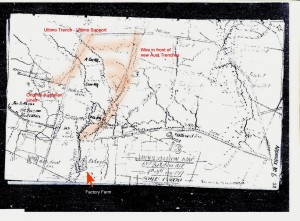
Exciting news from one of our Australian team members, Michael. One of the main project aims is to see how training on Salisbury Plain influenced (if at all) the effectiveness of combat units at Messines, specifically the Australian 3rd Division. We already have a large number of trench maps and aerial photos of the site from the Great War (thanks to another team member, Peter Chasseaud) but now have a specific map from the attacks of 7th June.
_
_
Michael has been to the Australian War Memorial in Canberra and has located the ‘Consolidation’ map of the 33rd Btn; the unit that was detailed to capture the German lines at ‘Ultimo’ and ‘Factory Farm’ craters. This shows the re-wiring and new trenching of the 33rd Btn following their Messines success. This map is produced below with new work (as of post 7th June 1917) shaded.
_
We will build this into our survey work and will hope to explore further this summer…
|
|
|
|
|
|
Filed under: A Dig Diary by
admin
1 Comment »
|
|
The German defenders Tuesday, July 3rd, 2007
|
|
|
|
|
I am putting together an historic outline of the German defenders of this location. It seems the mines hit at the junction of two regiments, the 9th Bavarians and the 5th Bavarian IR.
_
It seems the Ultimo mine went off just below the 12/9th Bavarian IR whose ranks included a fellow New Yorker who was listed as missing presumed killed.
_
I hope to have the full details and at least one map if not two shortly.
_
Ralph
|
|
|
|
|
|
Filed under: A Dig Diary by
admin
1 Comment »
|
|
It’s getting worryingly close to the first spadeful Sunday, July 1st, 2007
|
|
|
|
|
July. Crumbs, it’s July! At the end of this month we actually have to start digging holes and making sense of the site. At least we know we have a crack team in the field (no pressure guys) and some good friends waiting in the wings to help us out.
_
Last Friday Richard and I were pleased to see Dr Rob Janaway from Bradford University, who gave us some invaluable advice on conservation of finds. Although some of the techniques are standard for archaeological sites the relative newness of some of the materials, notably the organics, means that care and flexibility may be the order of the day. Between Rob and NML finds supremo Luke have excellent support.
_
In the meantime we are watching the weather and hoping that the pea crop in M. Delrue’s field will be lifted in time for the launch of the project. Watching the weather is a common preoccupation at the minute. Belgium has been having similar weather to the UK and Claude (patron of the excellent Auberge) has told us to bring our wet suits. Mind you, they were saying on the TV that it was the wettest June since 1914 and I keep comforting myself with the thought that July and August 1914 were remarkably good, giving that image of the Edwardian Summer that ends on 4th August (a bit like the project).
|
|
|
|
|
|
Filed under: A Dig Diary by
admin
Add a Comment »
|
|
|
|
|
|